Thursday, November 23, 2006

dietary help through the holiday

thought we could all use a little help with the release of our dietary intake over the holidays

Acupressure
for Weight Control


Apply steady, penetrating finger pressure
to each of the following points for 3 minutes.


1. Begin with 'Appetite Control' ear
point. This appetite control point can help you avoid overeating.
Begin your acupressure session stimulating this point. We suggest
that you end your session by stimulating these point
again.
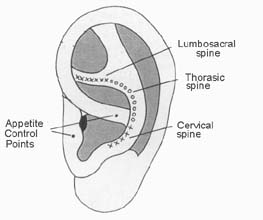


Appetite control point is located in your
ear. While looking in a mirror, place your fingers on your
jaw, in front of your ears. Open and close your mouth a few times
until you feel your jaw bone moving underneath your fingers. Put one
finger where you feel the most movement of the jaw. Your finger
should be right next to a little fleshy protrusion of the ear (not
the ear lobe). Grab this part of the ear with your thumb and index
finger and press with steady pressure.
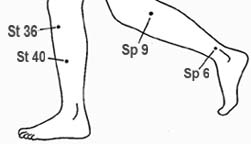


2. Spleen 6 (Sp 6) has a strengthening
effect on the digestive system.


This point is located on the inside
portion of your leg, above the ankle bone. From the center of the
ankle bone, slide up four finger widths. The point is just off the
bone, toward the back of the leg. When you find it, press with your
thumb or knuckle. Increase pressure until you are pressing quite
firmly, hold about a minute, and gradually release.


Caution: Do not press this point if you
are pregnant.


3. Stomach 36 (St 36) is the best point
to nourish the chi and blood. It has a beneficial effect on the
digestive system.


St 36 is located four finger widths below
the lower border of the kneecap and one finger width off the shin
bone to the outside. You've found the point correctly if you feel
the muscle move under your fingers when you flex your foot up and
down. Using moderate to firm pressure, hold for about one
minute.


4. Spleen 9 (Sp 9) This point is a close
neighbor of St 36. After pressing St 36, slide your finger across
the shinbone until you are just off the shinbone on the inside side
of the leg. Now slide your finger upwards along the shinbone towards
the knee about an inch, until you fall into a natural depression. Sp
9 is in this depression, right below a rounded prominence in the top
of the leg bone (tibia). This point is involved with the regulation
of water metabolism in the body.


5. Stomach 40 (St 40) An important point
for clearing excess damp and phlegm. It is also useful for
eliminating excess weight.


St 40 is located


6. Large Intestine 11 (Li 11) is useful
for clearing excess heat and damp from the body and to regulate
intestinal activity.


Li 11 is located at the outer end of your
elbow crease on the thumb side. Hold your arm in front of your
chest, as if holding a cup in your hand. The point is at the outside
end of the crease on your arm at the elbow joint. Another way to
find it is to note the length of your thumb from the tip to the
first joint, then move this distance up from the outside tip of the
elbow bone toward the crease lines at the elbow joint. Hold your
left hand close to your chest and use firm pressure with your right
thumb; press for about a minute, then switch arms.


7. Liver 3 (Lv 3) prevents chii
stagnation in the body and is the most important point for combating
stress.


Lv 3 is situated on top of your foot in
the webbing between your big toe and second toe. Start at the web
margin of skin between the two toes, and slide your index finger up
between the bones until you feel a depression about 1/2 inch up.
Still using your index finger, press between the bones (in the
direction of the root of the second toe). Start with light pressure,
as this point can be sensitive, and increase as much as you can
until you are using moderate to firm pressure. Press for about 1
minute.


The following two steps (8 and 9) are
optional.


8. Four Gates relaxes the nervous
system.


9. Neck and Shoulder Release will help to
relax and calm you as you make the transition to a new dietary and
exercise regime.


10. End your Acupressure session by again
stimulating the appetite control point on both ears.

Monday, November 13, 2006

Home Remedies for Muscle cramps and spasms

One of the easiest ways to deal with muscle spasm is to have a hot bath or shower. You can also do some simple stretch exercises. This will improve blood circulation and help the connective tissue around the muscles. Before you pump up those muscles, hit the showers, it can prevent any occurrence of muscle spasm. But make sure you also do a good cool down after the workout.

Muscle spasm mainly happens due to calcium deficiency, so include calcium in your diet. You can find good source of calcium in low-fat dairy products such as yoghurt, skim milk and ricotta cheese. Before eating and drinking calcium rich diet, consult your doctor.

If you are prone to muscle spasms it may be because of the acids that interfere with the body's ability to absorb calcium. Lessen the intake of acidic foods like tomatoes and vinegar. Inadequate supply of potassium to your body is another reason for muscle spasms. Increase your intake of potassium, eat good amount of bananas, potatoes, soya flour, bran wheat, ready-to-eat apricots, tomato puree and such.

Do not exert yourself by overusing your muscles. Take it easy for while and relax. Too much of physical exertion takes its toll on the body. Frequent muscle spasms could be the manifestation of this over exertion. If while doing some activity you get a muscle spasm, take a 15 minute break. This prevents muscle spasm in the long run.

Celery seeds have anti-inflammatory properties. It can reduce arthritic pain and relieve muscle spasms. Cramp bark (Viburnum opulus) can be used to treat muscle spasms. Hot and moist herbal packs are very useful in increasing blood circulation. It can treat painful areas by consuming tea or juices to soothe muscles and nerves.

If you get a muscle spasm while you are lying in bed, stretch your leg straight out, bend the toes back towards the head. Hold this position for 30 seconds, relax and continue till the cramp is gone. This stretches your calf muscle. This can also be done while you are standing.

Spasms usually occur when your body is exerted, mainly in the gym. Keep yourself hydrated as you tend to lose valuable electrolytes, which is required to prevent cramps. Before exercising you can take calcium, magnesium and potassium supplements daily.

Chamomile tea helps in relieving muscle spasms. Glycine, an amino acid present in the tea, help relax the muscles. Magnesium deficiency is usually caused due to alcohol, renal disease and diabetes mellitus. This tea is always nice to have before going to bed.

To stop muscle spasms use this ayurvedic solution. Soak your feet in a large tub of hot water, steeped with homemade tea bag of black or brown mustard seeds, for 15- 20 minutes.
You can use an herbal oil massage by using 1 cup extra-virgin oil or almond oil, add herbs in tincture form like 1 ounce Cramp bark, 1/2 ounce Lobelia, 11/4 ounce of Willow bark or Wintergreen ( wintergreen tincture is not available you can use 30 drops of wintergreen oil). You can store all these in a jar or bottle and use it as massage oil.

Warning: The reader of this article should exercise all precautionary measures while following instructions on the home remedies from this article. Avoid using any of these products if you are allergic to it. The responsibility lies with the reader and not with the site or the writer.Article Source: http://info.chinaitgi.com/Information/Natural-Remedies/131956872.html

Sunday, November 05, 2006

soothing pain relief

As the weather becomes more fall like and we spend more time in activities that extend our muscles in ways that let us know we're not kids anymore, the need arises for some immediate relief.

Using ice is the best natural pain reliever that we can put on those aching muscles. Most muscles are sore because of friction and swelling from over use. To reduce friction &/or swelling use ice. This is good for during our busy day's.

More soothing is using heat. Heat is not often recommended with out alternating it with ice. I have found that taking a nice hot bath/soak in Epson salt for a good 15-20 minutes is absolutely wonderful. Then crawl into bed. This is very important in allowing the muscles to release naturally. You will feel very good coming out of the warm water and will want to take advantage of this loose feeling. Don’t. just get into your bed and let your body relax. If you do too much with heated muscles you will cause the friction to increase and possibly do more damage.

Another soak you can put into the bath water is grated ginger. This is often used in Chinese Medicine. Ginger is a warming herb whether taken internally or used externally. Grate about ½ cup and put it in a nylon sock or cheesecloth tie closed and place it in the bath water. Also soak for 15-20 minutes and do as in the above soak.

Of course adding some really nice warming cider or ginger tea while soaking just adds to the overall benefits.

These are old time remedies that still work and are simple to do. The best part of these are that we take time for ourselves. That is the most important thing in maintaining proper health & well being.